

A Brief Story of Herbs in Norway: Their Histories, Properties, and Uses to this Day.
When I first came to Norway almost 20 years ago, I quickly realised what a different climate it is up here in the North. I remember clearly my first long walk in the Norwegian woods around Oslo, where I saw herbs growing that I had previously only known from the high alpine regions in Switzerland. It did not take long before I fell in love with this beautiful country, as well as the calmness and kindness of the Norwegian people.
Thinking about the climate here—the long winters, especially in the mountains and
the vidda areas (the Norwegian word for a wide-open mountain plateau), the short
summers, and even shorter springs and autumns—it is clear: herbs growing here
have to be strong.
I will try my best to express in words and pictures the strength of this beautiful, wild,
and sometimes very rough nature here, and to introduce some of the medicinal
plants and trees native to this part of the world.

Photo: Volldalshøgda (Røros Mountain Plateau)
Herbs, used by the vikings:
Knowledge about plants was recorded mostly by word of mouth until the 13th
century, when the Håvamål-which translates to ‘the Sayings of the High One’- was written down. The Håvamål is a collection of Old Norse poems from the Viking Age, in which many healing benefits of trees and herbs are mentioned.
Other very old sources are black books (grimoires), which were written in an era before modern doctors existed. They describe wise women who were known for their healing powers and witchcraft, and they contain a wealth of information about herbs based on practical experience. The country’s oldest preserved black book dates from the transition between 1400s and 1500s. It is located here in Oslo, safely kept in the basement of the cathedral school.
(unioslo_titan, 2023)
Angelica archangelica
The Vikings mostly used the stems and leaves as an important food source, and they
were well aware of the benefits of the root for weak digestion, breast pain and skurvy.
They described it as sweet and modern research suggests that it was actually one of the sweetest tastes available at that time.
(unioslo_titan,2021).
Later on, angelica was cultivated all over the country and was mentioned in the Kings’ Sagas of the 12th century. There are more than 700 place-names that include the Norwegian word for the angelica plant (kvann), including three mountains named Kvannfjellet (‘Angelica mountain’). For many generations angelica has been an important export product.
Photo: Angelica in the spring, summer and late summer at the Botanical Garden in Oslo

Spring

Summer

Late summer
Gentiana purpurea

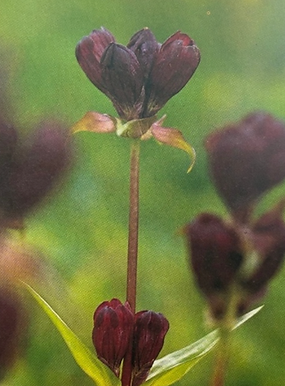
Photo taken by Pål Hermansen. In his book: Våre vakreste fjellplanter.
Another important plant that is mentioned early in Norse history is Gentiana purpurea. This
medicinal plant was, alongside angelica, a highly significant export item.
In some places, it was even used for beer-making instead of hops.
In the oldest existing Scandinavian medical book about the use of herbs, written by Henrik
Harpestrengs in 1244, Gentiana purpurea is described as the best remedy for the plague.
Other ancient herbal books describe it as a remedy for colic, vomiting, poor appetite, throat
diseases, and oedema. The root was traditionally mixed with butter or cream and used as an ointment to treat joint pain and rheumatic diseases.
(Aage Bjertnæs, 1997)
The Norwegian name for Gentiana purpurea is søterot, which means ‘sweet root’, even
though the plant’s root is extremely bitter. An explanation for this comes from ancient
times, when people believed in elemental beings. They believed, that healing spirits lived
within the plant and that they had to treat it with deep respect and give it a positive name to
avoid offending them.


Photo: Gentiana in the late summer at the botanical garden in Oslo
Our best-known contemporary herbalist in Norway, Rolv Hjelmstad, describes this wonderful
plant as a stimulant for the production of saliva and bile. It increases nutrient absorption in
the intestines and is primarily used to treat poor digestion, fever, and jaundice.
Rosenroot (Rhodiola rosea): Norway’s Native Adaptogen
Roseroot is a perennial plant in the Crassulaceae (stonecrop) family. It is a succulent and typically grows to around 30 cm in height. Roseroot is the only Norwegian species in the Rhodiola genus (Bjørkan, 2026).

Photos: Rosenroot after flowering at the Botanical Garden in Oslo
In Northern Norway a thousand years ago, a law existed stating that trespassing where
rhodiola grew was strictly prohibited. Rhodiola was known to possess magical powers, and
an old legend says: ‘’The man who has access to the rhodiola root will live and possess
strength and vigour for two hundred years.’’
The Vikings used the plant to treat hangovers and to prepare for battle. They ate the root
and called upon Odin, the God of war, before they left to fight. Cooked brews of rhodiola
were said to cure most diseases and were also used to prepare women for childbirth.
Monks from the medieval period described it as having astringent and tonic properties. As a
poultice, it was considered excellent for foul-smelling wounds, jaundice, and other internal
aliments. Later on, rhodiola was grown in turf walls and on turf roofs to protect homes
against fire. (Hedman, 2000).
The common people consumed it as food and for pains and sprains, they cooked a porridge
made from oat flour and rosenroot to use as a poultice on the affected area.
In modern Norway, Rhodiola is probably the most well-known and scientifically recognised
herbal medicinal plant. It is used as an adaptogen and it is known to have a strengthening
effect, works as powerful antioxidant, help with physical and mental stress, and improve
oxygen uptake. (Hjelmstad, 2012).


The male rosenrot plant has yellow flowers and the female has red flowers The Image is from the book:Gyldendal’s Nordic Field Flora..The picture is taken by Pål Hermansen for his book: Våre vakreste fjellplanter

The herbal medicine of the Sami people
(The Indigenous people from the northern parts of Norway, Sweden, Finland and the Kola Peninsula in Russia)
Sami family photo from the book: ‘’The Laplanders’’. And: Painting by Sophus Tromholt, ‘Under the Rays of the Aurora Borealis’, 1885’

The Sami live-and have always lived- in a very harsh climate. There is much more limited variety of herbs in that region, which may be why they are so deeply connected to nature and simply use available food as medicine. When visiting a Sami family during cold autumn or frosty winter days, you might be served a large cup of tea with crushed juniper berries, or coffee containing dried reindeer meat. As a source of vitamin C, they have always used angelica and cloudberries.
Other wild foods and herbal medicine growing up north include angelica, rosenroot, lady’s mantle, yarrow, willow bark, birch and of course juniper.
A very well-known medicinal remedy is the chaga mushroom, which grows on birch trees. It is still considered sacred, and no one harvests it without first asking the tree for permission. I was fortunate enough to join the Sami people in gathering it, and I was deeply moved by the profound respect they show for both the tree and the medicine.
Juniper: One of the Most Important Trees for Centuries
Juniper is widespread throughout Norway, growing up to 1,700 metres above sea level. You can find them as bushes, but also as trees up to 12 metres high. The tallest measured juniper tree was 17.5 metres-the Glenne juniper in the Østfold municipality.
In mountain and coastal areas, it usually grows surrounded by heather. Especially in autumn, the evergreen juniper surrounded by a reddish-violet ‘’heather fire’’ looks magnificent. For many centuries, it was perhaps the medicinal plant that saw the widest use in the country, playing a major role in Nordic folklore. It has been considered sacred and held in high honour, not only in pagan times, but across northern regions and rural communities right up to the present day.
Juniper growing in the Alvdal mountain plateau

Juniper branches were burned as incense to ward off dark evils and illness. It was common practice to burn juniper in maternity wards to protect mother and child while keeping trolls and evil spirits away. Furthermore, it was used for smoking fish, brewing beer, and making a decoction of juniper boughs and berries, which was used in the kitchen for cleaning and extending the shelf life of food.
Even back then, people knew about the medical benefits for treating convulsive diseases, kidney and bladder disease, and sore throats. A glass of crushed juniper berries was believed to stimulate memory and thought, and when boiled in milk, it was used against whooping cough-among many other things. Many juniper remedies were recorded in notebooks on farms by carpenters and farmers around the 1850s-including the practice of using juniper smoke to disinfect rooms where a sick or deceased person had lain. (Berg, 2020).
Dried crushed juniper berries are an ancient Norwegian spice, and to this day, no reindeer soup exists without them. They are used as a spice in game sauces, venison dishes, marinades, and for curing fish. The berries are also used when brewing traditional beer. The twigs and needles provide a wonderful smoky flavour when smoking meat and fish, and juniper berries are what give Norwegian gin its distinct character.

Juniper among autumn blueberries in the highlands (Alvdal)
The tradition of the Nordic herbal Sauna: The Importance of the BirchTree, and the Function of the Birch Whisk
In Nordic sauna culture, the birch whisk is called a vihta (a Finnish word) or vasta. It is used in saunas across Scandinavia and Russia. It not only enhances the physical sauna experience but also has deep, healing effects on both body and mind.
Fresh birch twigs, bundled together into a bouquet, are used for therapeutic and ritual purposes. When swept across the body in very high temperatures, it immediately increases blood circulation and soothes the nerves. Additionally, it smells wonderfully good, cleanses the skin, and releases toxins. For chronic muscle ailments, the birch whisk can contribute to rapid muscle recovery.
However it also helps to clear the mind and unlock mental peace, instantly connecting you with the tranquility of nature. Throughout the country, this
tradition is regularly practised to this day, all year round.
There are many texts and stories about birch and its powerful health-promoting effects. For instance, it is claimed that King Sverre and his men, while on the run in the wilderness, sucked sap from birch trees to prevent themselves from developing scurvy. (Berg, 2020).
Additionally, the name Birkebeiner comes from the fact that the original rebels were so poor that they wrapped birch bark around their lower legs and feet as footwear to stay warm and protect against the snow; the word literally means ‘birch leg’ (Lokalhistoriewiki, 2024). This group is also famous for the historic rescue of the infant King Haakon in the year 1205.
To this day, it remains common to tap and drink birch sap, as well as to drink birch leaf tea from this famously health-promoting tree.

Photo: The courtyard tree by the historic buildings in the Oslo Botanical Garden”
The Courtyard Tree (Tuntre)
Trees have always been very important, especially the courtyard tree (tuntre), which is a freestanding, centrally located tree in the farmyard.
In Scandinavian folklore, it was regarded as a sacred tree that protected the people, the animals and the farm. This tree was the symbol of the family lineage and the life of the farm.It was strictly forbidden to saw or break branches off the courtyard tree; doing so foreboded death and misfortune in the family. It was believed, that the gardvordens (the nisse or guardian spirit of the farm) lived beneath the tree’s roots, and it was very common to bring him beer, meat, porridge and milk. The courtyard tree was always a deciduous tree, and the most common species were ash, birch, maple and oak.
The tuntre tradition still exists today, and many century-old farmsteads still have their
original tree. (Berg,2020)

I hope that I have been able to give you a tiny insight into Scandinavian nature, culture, people, and some of its wonderful herbs. It is a place that touches your heart much faster than you think.
Written by Andrea Fischbacher for the English herbal Medisin Association
References:
Berg, A. (2020). Trærnes magiske kraft
Trondheim: Communicatio Forlag AS
Bjertnæs, A. (1997). Groblad, meitemark og krutt.
Oslo: Gyldendal Norsk Forlag
Bjørkan, T. (2026). Rhodiola rosea - norskflora.no. [online] Norskflora.no. Available at:
https://norskflora.no/plante/?sle=Rhodiola&art=rosea [Accessed 3 Aug. 2026].
Borgen, A. (1979). Urtehagen på Knatten
Oslo: Gyldendal Norsk Forlag
Mossberg, B. And Stenberg, L. (2010) Gyldendal’s nordiske feltflora.
Oslo: Gyldendal.
Hedman, S. (2000). Rosenrot.
Öland: Mika Forlaget
Hjelmstad, R. (2012). Medisin-planter i Norge
Oslo: Gyldendal Norsk Forlag
Høst, P. (1964). The Laplanders: Europe’s Last Nomads
Oslo: Dreyer forlaget
Lokalhistoriewiki.no. (2024). Birkebeinerne – lokalhistoriewiki.no. [online] Available at: https://lokalhistoriewiki.no/Birkebeinerne
[Accessed 2 Aug. 2026].
Solbakk, A. (2018). Nature heals - an introduction to the tradition of sami folk medicine
Karasjok: ČálliidLágádus Publisher
unioslo_titan. (2021). Kvann: Søtsaken fra vikingtiden som forsvant – og gjenoppsto - Titan.uio.no. [online] Available at:
https://www.titan.uio.no/andre-temaer/2021/kvann-sotsaken-fra-vikingtiden-som-forsvant-og-gjenoppsto.html [Accessed 21 July 2026].
unioslo_titan. (2023). Svartebøker og gammel folketro inspirerer moderne medisin - Titan.uio.no. [online] Available at:
https://www.titan.uio.no/naturvitenskap/2023/svarteboker-og-gammel-folketro-inspirerer-moderne-.html [Accessed 21 July 2026].